

The Return of Men & Supermen… sort of
This Monday is Miracle Monday, the Earth-wide fictional celebration whose origin is Elliot S! Maggin’s wonderful Superman novel of the same name. Something has happened, something that could literally have been Hell on Earth, but Superman saved the world and everyone in it. Not through brute strength or even through his alien, super-enhanced intelligence, but through his innate goodness, his moral upbringing by Jonathan and Martha Kent. The people of Earth remember nothing of those horrible days. They don’t know why they feel joyful. They know only that they do, as if some horrible evil has been lifted from them.
Shortly before four in the afternoon on the third Monday in the month of May, the people of the city of Metropolis learned the meaning of joy. They had no explanation for this feeling, and there were gaps in their knowledge of what had gone on in their lives so far that day. It was as though they were all waking up, or at least opening their eyes, for the first time in an awfully long time. The first thing many of them saw was the red-and-blue figure of Superman drawing a line across their sky, and he became the symbol of their joy. It felt like a miracle, though none could say why.
Miracle Monday is a wonderful book, a fine companion to Maggin’s first Superman novel, Last Son of Krypton. Very few authors have fully recognized how the innate goodness of Superman is essential to his nature. Maggin is probably the best of that very small number.
I have Miracle Monday on my calendar to remind me to search my experiences over the last year for something worth blogging about on that day. It ought to be related to Superman or at least to superhero roleplaying or fiction. But since I don’t play superhero roleplaying games any more, or read superhero comic books—in both cases more through lack of opportunity than through lack of desire—I often skip over it.
I have, for a long time, been considering a complete rewrite of Men and Supermen, my own superhero game written and played throughout the eighties and nineties. While I play fantasy most often, superhero roleplaying is probably my favorite; from the moment I first played Dungeons & Dragons in 1980, I set my sights on a solid ruleset for gaming in a comic book superhero setting.
It’s based on classic Avengers, classic Justice League, and a bit of classic (especially Gerber era) Defenders thrown in. A handful of the better team adventures based around World War II also influenced it: The Invaders from Marvel, and All-Star Squadron from DC.
Outside of my own, the closest game to my vision is probably early Villains and Vigilantes. It is very important, for example, that the powers in a superhero game be powers and not collections of effects. Players should always be able to come up with new uses for their powers based on what the powers are. Magnetism control is the ability to control magnetism; it is not a restricted collection of effects colored by reference to a vague magnetic buzzword.
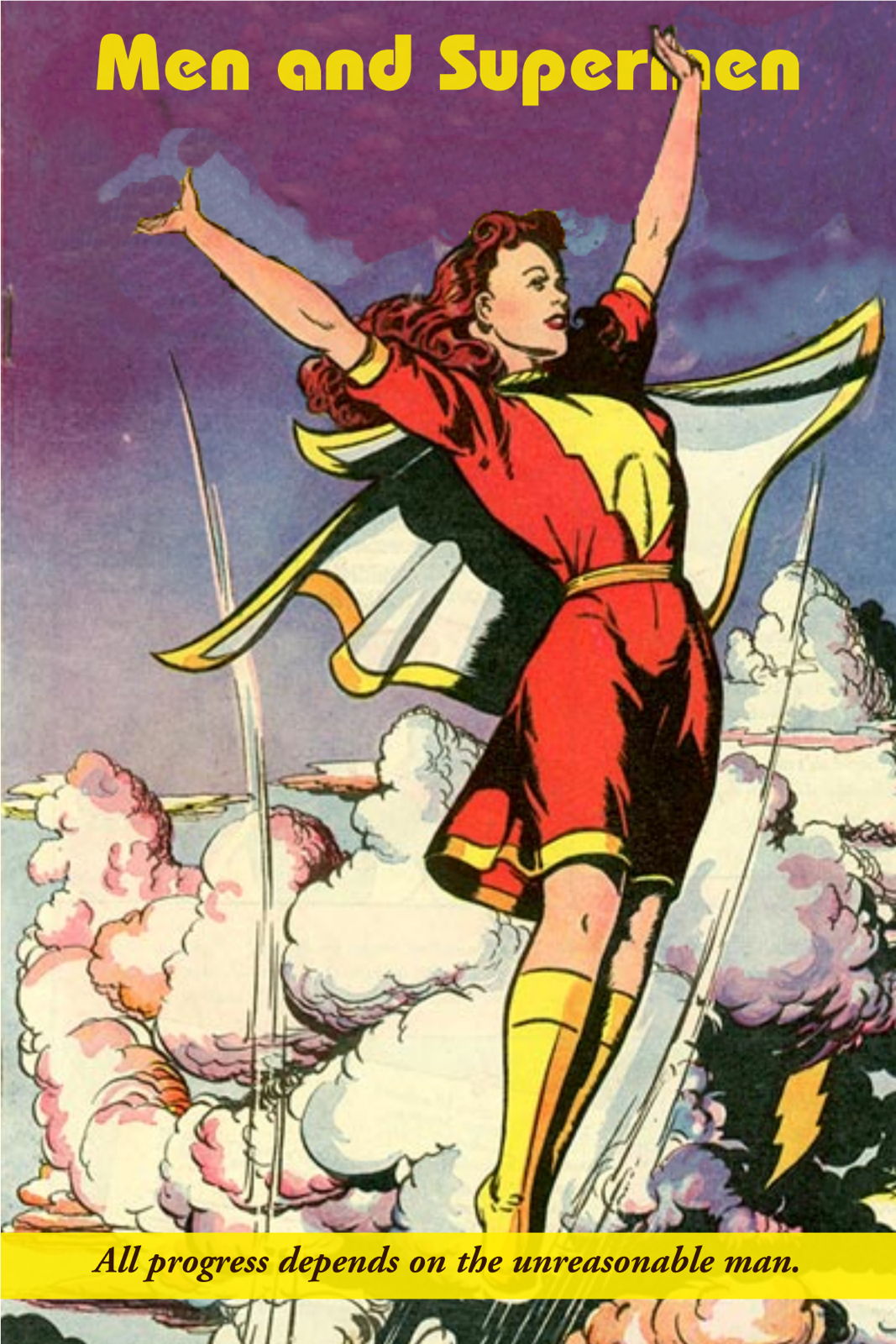
It’s a bad sign when you’re working on the cover before the content. But what I want is a game that recognizes the sheer joy of superheroes.
Superhero powers in a roleplaying game should, in other words, be subject to the expansive imaginations of players, and not the tinkertoy imaginations of game authors.
Where Villains and Vigilantes falls apart is emulating the sheer joyful scope of what makes a superhero. V&V will never support a group where Superman and Wildcat are in the same team. But as I wrote in its introduction,
Men & Supermen was designed to allow variable power between heroes. In comics, it is perfectly possible for a god to fight alongside an average human. The game system of Men & Supermen allows for this, without losing the differences between powerful and less powerful heroes.
The book also contains the first version of my What is Role-Playing page that was linked and copied often in the early days of the net.
My redirect site for www.menandsupermen.com had, at the beginning of the year, the dubious distinction of being the only part of my site that remains outside of my CMS. It was still a bunch of Microsoft Word files converted into frame-based web pages by way of conversion software so old that I can’t even remember what it was called. In that sense, Men & Supermen almost belongs in Tractor Feed Adventures.
So when I decided, this year, to finally complete the update of the roleplaying files that have been sitting in a folder on my desktop since 2007, Men and Supermen was obviously one that I wanted to complete sooner rather than later. By looking at what I did before, I can more easily contemplate what I want to do next.
And what better deadline to set for myself than Miracle Monday?
Converting the Men and Supermen rulebook to a modern word processor was harder than I expected it to be. The differences between the 1998 technology I last wrote these files in and the 2025 technology I converted it to was enough to cause serious issues. Converting from Word to Nisus was the least of the problems. Nisus, after all, is very easy to use.
Some of the auxiliary files, however, were even older than Word, going back to Stylograph on OS-9 on the TRS-80 Color Computer, and image files in formats long since lost. The worst was when I looked all over my hard drive for the three sample characters, and could not find them. Had I accidentally deleted the character sheets for Seraph, the Rainbow Wizard, and the Sphinx sometime in the last couple of decades?
No, or at least not completely. I finally found the first page of each of the three characters, the front page of attributes. There were pages for powers and spells and other abilities, too… but they were blank.
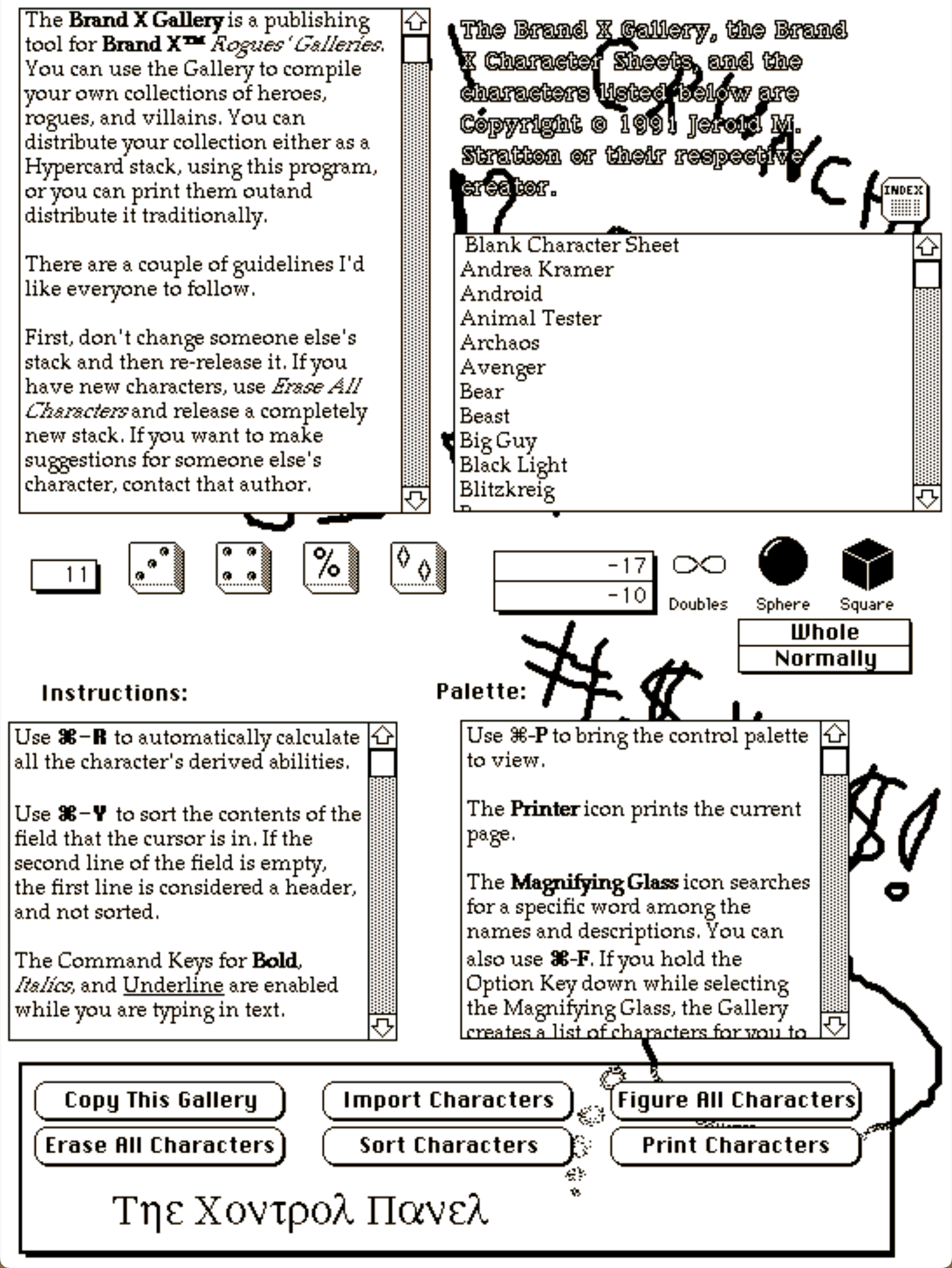
Oddly, those blank pages also had a different format than the corresponding pages in the book, which, on a closer examination, had a different format than the front of the character sheets in the book. The second (and third and fourth, for Rainbow Wizard) pages looked like a classic Macintosh screen.
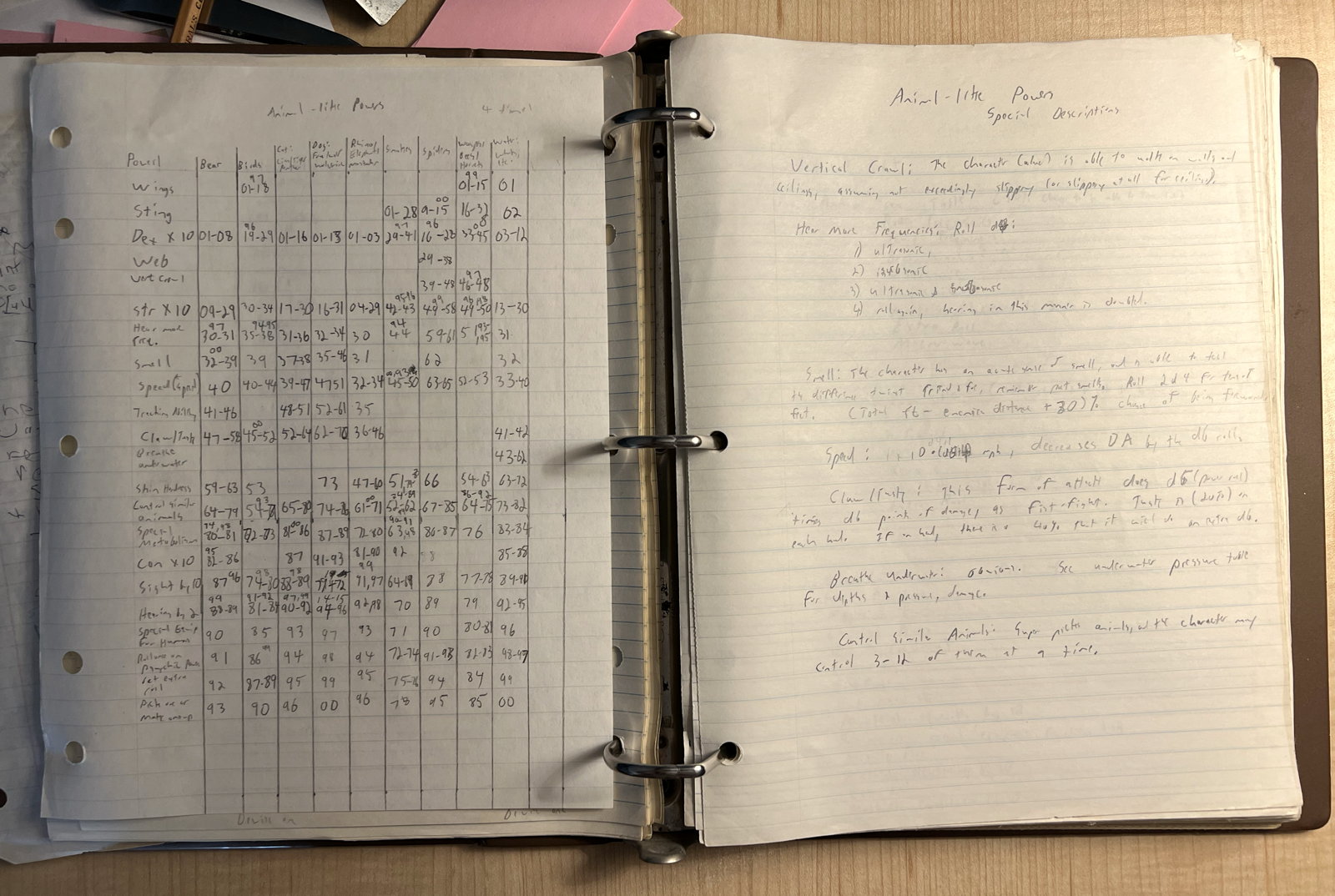
One of these days, I should probably scan my original draft. Do not hold your breath.
To describe it was to recognize it. They were printouts from a HyperCard stack. Technically I could have used the screenshots from HyperCardPreview in this new version, but the images in that stack weren’t particularly high quality to begin with. While I did keep the low-quality images elsewhere in the book, it made more sense to remake the sample sheets completely in Scribus. You can download the Scribus document with those three characters (Zip file, 378.1 KB) if you want a Scribus character sheet to store characters in.
You can also download the original blank character sheet from the Starter Kit.
To say that this was fun is an overstatement. The rules are not quite as bad as I remembered from the last time I looked at them a few years ago. But I have a suspicion that the only person who could really run this game well is the author, and I barely recognize that guy today.
For this reason, I made it a point not to fix or clarify the rules—I’m not enough in that headspace to be able to reliably know what the writer was thinking. I have fixed obvious typos—the random double spaces and double periods are gone—but I have left some less obvious typos in. They might have been there for a reason.
Similarly, I have tried not to alter formatting except as required by a modern word processor. I have, however, fixed obvious formatting errors, such as headlines having the wrong headline style, which in a modern word processor such as Nisus has the effect of putting subsections in the wrong section of the document.
The index is slightly improved, mainly because, again, it was difficult to adhere to the limitations of 1998. The only weird thing about the new index is that %Control and %Recognition are sorted under “C” and “R” respectively rather than under “%”. I don’t know how I feel about that in general, but in this case, trying to emulate the indexing of 1998 where even upper and lower case made for different entries, it’s slightly annoying. I’ve added them back in manually.
You can download the PDF—which now has a table of contents built in—or view the rules online. You can even, if you so desire, buy a printed copy.
And if you choose to run this at North Texas, I will definitely sign up to play it. But I have no intention of running it again myself.
Now, on to the Hero’s Guide! I will hopefully have that project finished by next Miracle Monday. It would be a Miracle, indeed…
book
- Men & Supermen: Jerry Stratton at Lulu storefront (paperback)
- Enter a world of Men… and Supermen.
- Men & Supermen
- Men & Supermen is a superhero role-playing game designed for a wide variety of characters, both of powers and power levels.
- Men & Supermen Rules (full PDF)
- PDF version of Men & Supermen Rules
- Scribus Men & Supermen Character Sheet (Zip file, 378.1 KB)
- The sample characters from Men & Supermen, in Scribus, easily used for your own Men & Supermen character sheets.
Gods & Monsters
- A Contrived Example of Game Play
- The Order of the Astronomers is an example of what might happen when player characters delve into the wilderness, discover lost ruins, and encounter monsters, traps, and fantastic adventure!
- Tractor Feed Adventures
- Old adventures, not worth converting to Gods & Monsters. I haven’t played these since the eighties.
Men & Supermen
- The Brand X Hero’s Guide
- The rest of the rules tell you how to create a superhero, what your numbers mean, and the rest of that shit. This book gives you some pointers on how to play the damn game. Consider this a primer on the physics, sociology, and politics of a world with super heroes. This is a world where anything can happen, and, sooner or later, everything does.
- Men & Supermen Character Sheet
- This character sheet is also a character gallery. Go to it cold and it will create the basis for a random character—including cool-sounding superhero name. Are you ready to meet THE SOUL THUNDER?
- Men & Supermen Starter Kit
- This is what’s left of the starter kit: PDF versions of the character sheet, character creation outline, character creation worksheet, editor’s screen, and editor’s record sheet.
- What is role-playing?
- Role-playing is getting together with friends to write a story. It’s joining around a campfire or a dining room to spin some tall tales. Role-playing is being creative and having fun with friends.
programming
- JXA and AppleScript compared via HyperCard
- How does JXA compare to the AppleScript solution for screenshotting every card in HyperCardPreview?
software
- A HyperCard Time Machine
- Use AppleScript and HyperCardPreview to archive a screenshot of every card in a HyperCard stack.
- HyperCard: The software erector set: Uli Kusterer
- What was HyperCard? Plus stacks, alternatives, and communities.
- Nisus Writer Pro 2.0
- The new Nisus is pure awesome: very easy to use, and it does everything I need.
- Scribus
- Scribus is a very nice open source page layout application and includes full PDF creation. It is also scriptable using Python if you need to automate page layout tasks. Scribus is very useful for making documents that need to be shared with other editors, since anyone can get the Scribus application unrestricted.
- Stylograph at Retrocomputing
- “Stylograph was created by Great Plains Computer Co. in Idaho Falls, Idaho. It was sold by Sonex Systems in Williamsville, New York for the FLEX OS. The product was formerly called STYLUS. The product was ported to OS-9 and UniFLEX.”
superheroes
- Dr. Strange’s record collection
- Greg Hatcher praises Steve Gerber’s seventies comics, including Omega, the Defenders, and the Phantom Zone.
- The Rambling Face of V: V for Von Neumann
- Alan Moore’s view of progress and the coming singularity combines the John Von Neumann’s optimism with Norbert Weiner’s pessimism.
- Superman: Last Son of Krypton
- “Last Son of Krypton” explores the responsibility of power and the side-effects of universal good deeds through the super-powered adventures of Superman.
- Superman: Miracle Monday
- “On that day, according to the book, resort owners on the glaciers of Uranus raise ski-lift tickets for the influx of tourists. Teamsters driving slow-moving cargo transports to Earth from mining operations in the asteroid belt get drunk and silly like sailors crossing the Equator for the first time… There are laughter, reflection, public celebration with barbecues and holographic light shows all over the solar system, merriments of all sorts.”
- Villains and Vigilantes at Monkey House Games
- The best superhero game of the old-school, and possibly still, V&V is an easy game to read and play.
More Men & Supermen
- Villains, Rogues, and (Super) Heroes from 1992
- While looking through my Men & Supermen folder to import A Taste of Jasmine into my CMS, I discovered that I still have a copy of the M&S rogues gallery book.
- Welcome to Men & Supermen fans
- The Men & Supermen superhero role-playing game has been added to the automated publishing system used for Gods & Monsters.
More superheroes
- Astro City: Hope to Hopeless in the Big City
- Kurt Busiek set himself a noble and desperately needed goal when he started Astro City, the reconstruction of the superhero.
- Mighty Protectors release: Villains & Vigilantes 3.0
- As of today, you should be able to buy both the PDF and the print version of Villains & Vigilantes 3.0: Mighty Protectors. It’s a worthwhile purchase.
- Superman vs. the X-Men
- Superman Returns wasn’t as good as I’d been hoping for, but it was very good, and much better than X-Men 3.
- Batman Begins
- A surprisingly good film that marries comic book sensibilities to the big screen in a way that uses and improves the strengths of each. This is the best Batman film ever, and a fine addition to the new series of superhero films.
- Superman: Last Son of Krypton
- “Last Son of Krypton” explores the responsibility of power and the side-effects of universal good deeds through the super-powered adventures of Superman.