


-
 A High Crusade for Flashing Blades—Wednesday, September 9th, 2026
-
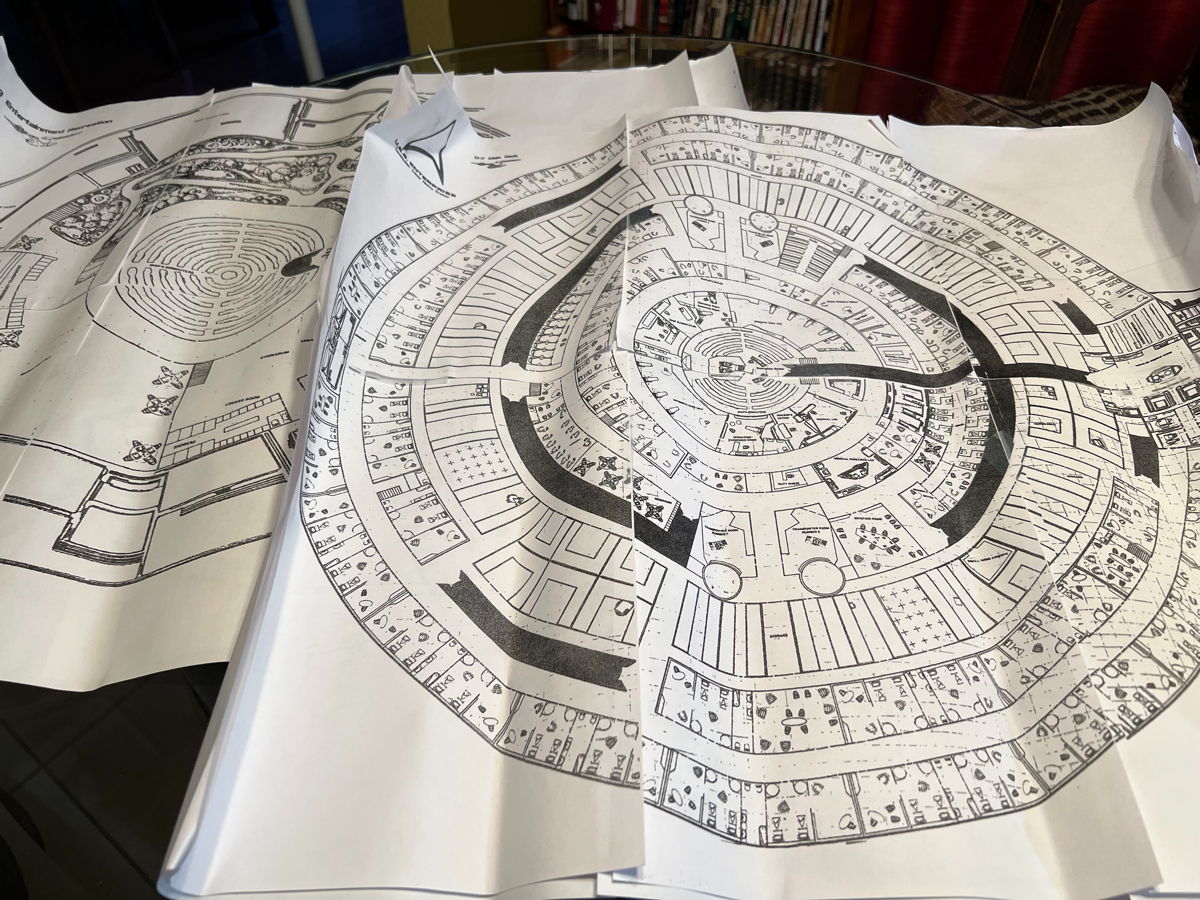
GraphicConverter made it easy to print a large map on multiple sheets for taping together.
La Croisade Élevée (PDF File, 4.3 MB) marks the end of my Mirror Universe duology for Flashing Blades. This sequel to last year’s scenario was inspired by a throwaway act from one of the players in my home group at the end of playtesting l’Entreprenante l’Entreprenante.
I hadn’t planned to run two sessions of Trek’s Mirror Universe in Flashing Blades. The idea for the 2025 session was just to put Trek officers on the 1705 Enterprise at the moment it supposedly changed hands from the French to the English and set in motion the chain of naval ships that led to Star Trek’s NCC-1701. It was to be an interim game before running my Super Secret Flashing Blades project designed to be a more long-term game like the annual Daredevils Kolchak game I also run at North Texas.
But at the end of running the first draft of l’Entreprenante l’Entreprenante for my local group, one of the players tried to follow the Trek officers back to the Enterprise. And I immediately had flashbacks to Poul Anderson’s The High Crusade.
I knew I wasn’t going to finish my super-secret Flashing Blades project by June 2026, so I set to work on this adventure. Of course, I wasn’t going to call it The High Crusade. As with the first, non-Trek game and the first Trek game I chose to title it in bad French. The game became La Croisade Élevée.
-
The recipes of Lee Gold and Alarums and Excursions—Wednesday, June 17th, 2026
-
June 22, 2026, marks the fifty-first birthday of what was probably the longest-running gaming forum of its era, and probably well into the future. In the announcement for my personal cookbook, A Traveling Man’s Cookery Book, I wrote, about publishing personal and family recipes:
The preservation of food culture would be better if everyone did this or something like it. I wouldn’t buy everyone’s paperback, but I would download a lot of PDFs.
“A few of my friends”, I added, “make their Word documents and text documents of family recipes available on request”.
I very specifically had Lee Gold of Alarums and Excursions fame1 in mind when I wrote that. Alarums and Excursions started in June 1975 and ran up to and including April 2025, almost fifty full years. I contributed to Alarums and Excursions from at least April 2008 to its end, with The Biblyon Free Press. At some point I started including vintage food, that being my other obsession after gaming. The road to seeing Lee Gold’s recipes began when I reviewed the ca. 1955 Home Cooking Secrets of Charlotte in the April 2021 issue, A&E 545.
Lee replied in issue 546:
I could email you our Recipes files if you want to see them. One file is my transcription of my father’s mother’s recipes, given her by friends and relatives when she left Virginia for Los Angeles (June 25, 1895). Another is my father’s and my mother’s recipes. The third is Barry’s and my recipes plus those of some of our friends.
When I replied that “I’d love to see your recipe files”, she sent three documents:
- Some Recipes of Howard and Judith Klingstein
- Leonora Wise Klingstein’s recipe book
- Lee Gold’s Recipes
All of the recipes in these files come from either her file of recipes from her parents (Howard and Judith Klingstein, the first file), from her grandparents (Leonora Wise Klingstein, the second file), or are her own recipes from, among other sources, friends in the science fiction and gaming community (the third file).
-
Kolchak: The Tall Sister (a Daredevils adventure)—Wednesday, June 3rd, 2026
-

- Item. Chicago. March, 1977. When “Boss” Richard J. Daley died December 20, Michael A. Bilandic was appointed acting mayor until a special election could be held, promising not to run himself.
- Item. He’s now the front-runner.
- Item. A few months ago, the driver of an El train plowed into the train ahead, throwing El cars into rush hour traffic and killing eleven people.
None of this, of course, matters to Carl Kolchak. He’s much more interested in the obscure and forgotten death of the El motorman’s girlfriend in an indigent hospital on the west side. Out beyond Greektown, beyond Little Italy, the ethnicities blend and mix, and it’s hard to tell who you might meet in the dark of night.
It was the Ides of March, and a woman was the author of the deed—or was she? It was a classic locked room mystery. A witness claimed to see a woman walking away just after the death… beyond the window of the fourth floor. The events of March, 1977, were impossible. Impossible, and yet, they happened.
Welcome to my fifth annual Kolchak: The Night Stalker adventure (PDF File, 4.6 MB), using the Daredevils rules. As you read this I may very well be running the sixth.
Of interest to Blues Brothers fans, the National Socialist Party of America has not yet won their lawsuit to march in Chicago, but the lawsuit is on and making news. You can use any or none of this if you run this adventure, depending on how complicated or how long you want it to run. That plus Bilandic is all background. It’s what the rest of Chicago is doing while the player characters are plunging into unverifiable things that cannot happen here.
I ran the adventure as a four-hour convention game at North Texas in 2025, so I included only the minimum around the mystery itself, culminating in a fight with a vampire… but not that kind… in a storage facility at dusk.
As is my habit for these adventures, the adventure is mostly a locale and a group of Night Stalker stringers doing their own thing.
-
L’Entreprenante l’Entreprenante: Mirror Universe Trek for Flashing Blades—Wednesday, September 10th, 2025
-
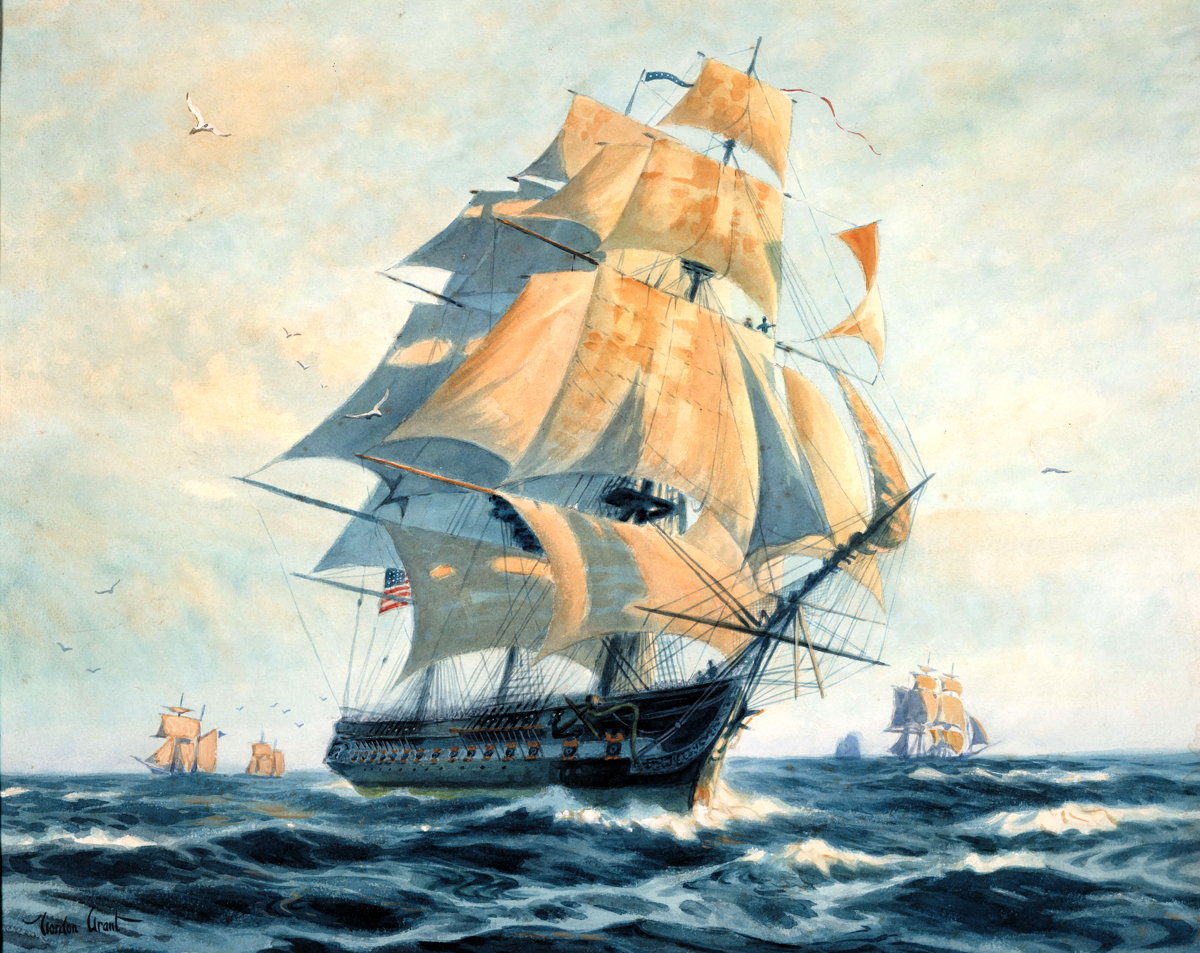
This 1927 painting by Gordon Grant in the USS Constitution Museum depicts the USS Constitution. It’s very similar to what l’Entreprenante would look like.
I ran a second game of Flashing Blades at North Texas in June. It was a blast. The idea was that the crew of the mirror universe Star Trek from the Mirror, Mirror episode were stuck on a 1705 French warship (PDF File, 2.6 MB) until they could right the timeline to restore the Enterprise from whatever their own meddling in time had done to it.
Much as the Federation timeline crew had to do in City on the Edge of Forever. In fact, I incorporated that episode into the history of the Mirror Universe, but my fictional Mirror Universe crew had instead had to ensure peace activist Edith Keeler’s survival rather than her death.
I incorporated the High Seas supplement into the adventure, but I didn’t realize what that meant until I, fortunately, ran a test of the adventure with my local group. Given the backstabbing, power-hungry nature of the Mirror Universe crew I expected lots of sword fights, both between the Enterprise and l’Entreprenante crews and among the ambitious Enterprise crew.
In fact, the draw of this game was the ship combat. After running the first game locally, I added a simple ship-to-ship combat at the beginning of the game against a weaker ship as a likely possibility. This contrasts with a more dangerous ship-to-ship combat at the end of the game against a stronger ship. It also gives the players a handle on how ship combat works in Flashing Blades before the big fight at the end of the adventure.
This change also made the 18th century crew more active with respect to the 23rd century crew.
After the playtest I also modified one aspect of High Seas combat. High Seas provides five ship ranges: Far, Long, Medium, Short, and Close. This means that chases are over much too quickly. I added Too Far (which provides two ranges that are too far for firing cannon) as well as Medium Long and Medium Short. This gives more time for ship-to-ship volleys, especially where both ships are bearing down on each other.
-
Plagiarism and copyright in RPGs—Wednesday, July 23rd, 2025
-

Plagiarism and copyright are two of the most misused terms in gaming. First, the differences. Plagiarism is about attribution. Copyright is about having a monopoly on copying and distributing. Copyright has nothing to do with attribution. If it would be against copyright law without attribution, it would be against copyright law with attribution. You can even plagiarize things that can't be copyrighted or that have returned to the public domain.
Plagiarism is not against the law. It’s just bad form in occupations where the source of ideas is often more important than the ideas themselves, mainly academia and politics. Not only is plagiarism not illegal, it’s not even generally bad form in freewheeling arenas where the focus is on the customer rather than the business. When Microsoft copies Apple, or Apple copies Google, or Frigidaire copies Whirlpool, or Steelcase copies Knoll, that’s not plagiarism. That’s getting better products to the customer.
In my opinion, the latter is where roleplaying games should fall as well. The gaming industry is fortunately still about better games for gamers, by gamers. It’s not publish-or-perish. It’s game-and-live. If there’s one lesson we can learn from the old-school, it’s that gaming rules. Publishing is secondary. Scholarship is tertiary. Gaming is the reason we’re gaming and the reason we’re writing games.
I’ve written before that you can’t copyright ideas, and that collections of ideas is mostly where roleplaying games fall. The notion that one company or other can legally restrict the spread of ideas—in the form of mechanics, or names, or even tables and lists—is a common misconception among gamers.
This question comes up a lot in various forms, although not usually in as obvious a manner as recently on theRPGSite where “What Precisely is plagiarism considered in the OSR?” was misconstrued into questions like “Is it okay to copy a mechanic wholesale?” and “When is it okay to borrow or use a mechanic and not list inspiration?”
To which the very first answer was “Number 1: a mechanic is not copyrightable.”
-
Flashing Blades: Character Calculation Perl Script—Wednesday, July 9th, 2025
-
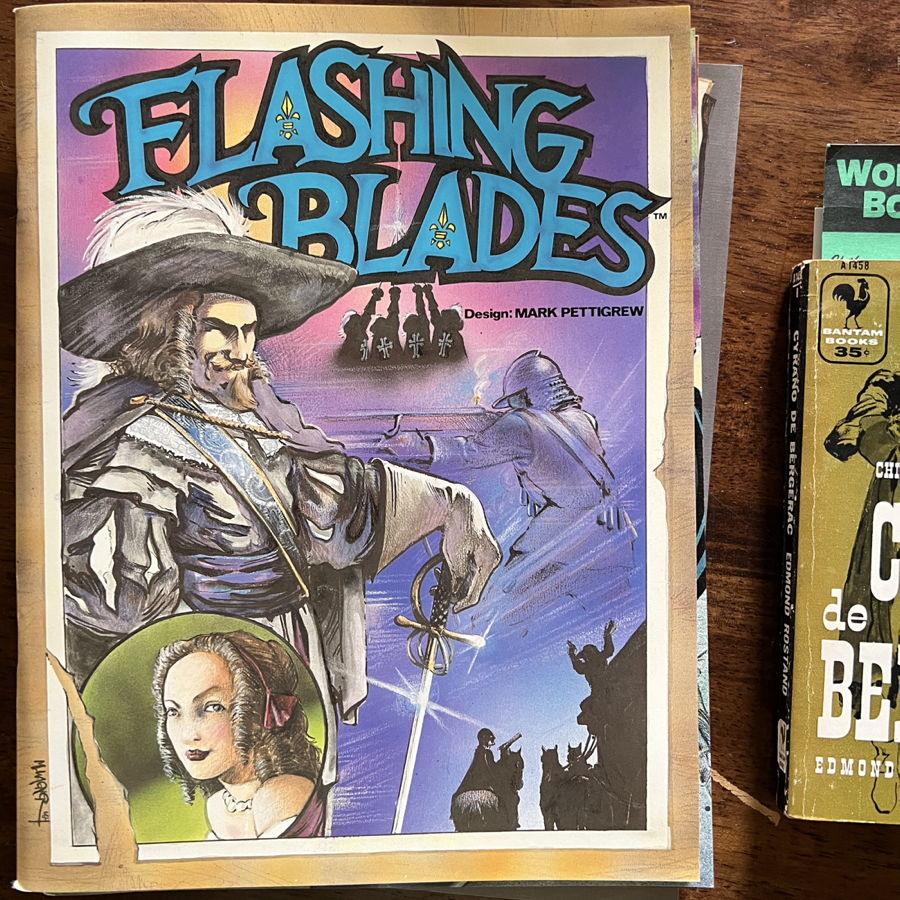
I ran Flashing Blades again this year at North Texas, and it required making a bunch of custom character sheets. There are a handful of calculations that are the same calculation for every Flashing Blades character: hit points, encumbrance, and initial skill points. There’s also the combat modifier, which may or may not be different for firearms and crossbows. And characters that have the right combination of Strategy skill and rank have a chance for Brilliant Maneuvers.
Once you start making skill choices Flashing Blades is difficult to program for, but it is very helpful to get those five calculations done automatically to avoid typos. While none of those calculations are difficult, it’s always easy to skip a line on a table or misread a column when doing multiple characters in succession.
I’ve designed the script to use a text file of attributes, using a simple Markdown headline to title each character. Just point the script to that file—or multiple files—and either get all of the characters or just ones that match a search term. Here’s an example of some characters I’ll be using:
- # Captain J. Tiberius Kirk
- Strength: 12
- Dexterity: 10
- Endurance: 14
- Wit: 13
- Charm: 15
- Luck: 12
- # Chief Science Officer Spock
- Strength: 16
- Dexterity: 15
- Endurance: 15
- Wit: 17
- Charm: 8
- Luck: 9
If I type
~/bin/flashing Characters/Enterprise.txt KirkI get:- # Captain J. Tiberius Kirk
- Strength: 12
- Dexterity: 10
- Endurance: 14
- Wit: 13
- Charm: 15
- Luck: 12
- Encumbrance: 12
- Hit points: 13
- Skill points: 11
- Martial adjustment: 1
- Brilliant Maneuver (requires Strategy): 5
-
Far Out, My Idol: A Kolchak adventure for Daredevils—Wednesday, June 4th, 2025
-
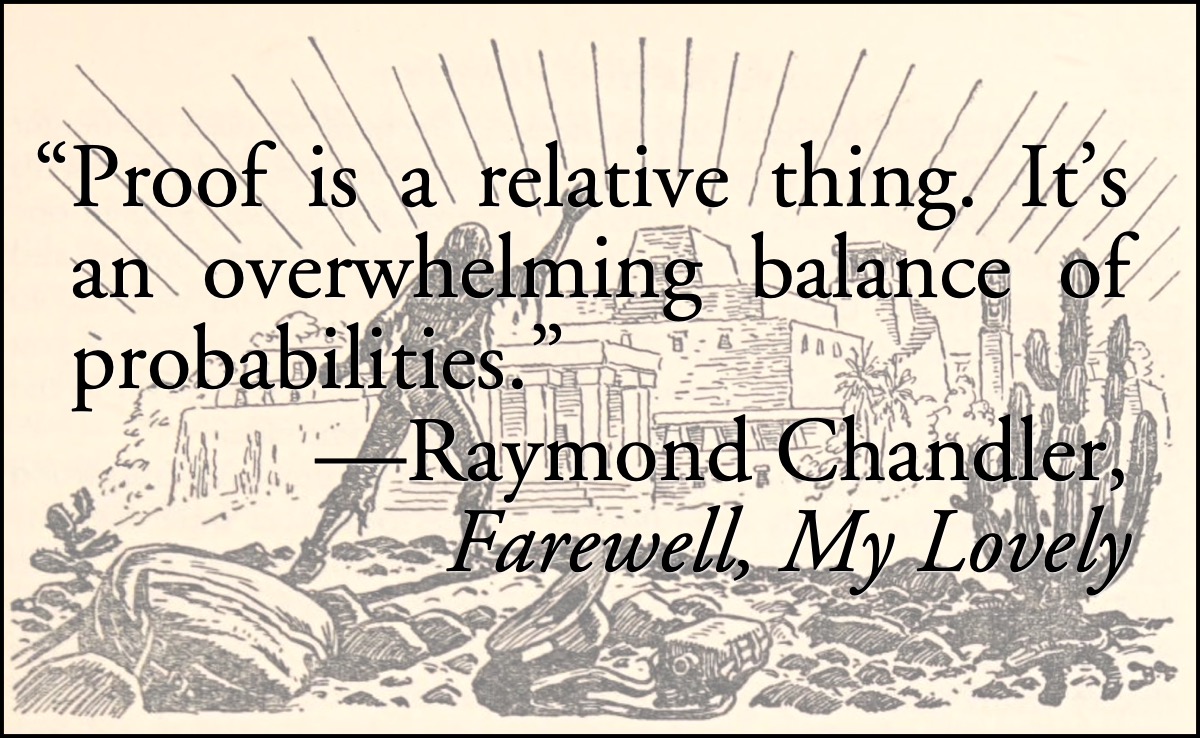
January 10, 1977. The temperature hasn’t risen above freezing for a week. Most days drop below zero. Scientists are speculating about a new ice age. Now, cold in Chicago is nothing new. Neither is cold-blooded murder. But what happened in Chicago in January of 1977 was so unprecedented, so outrageous, that even now I fear to reveal the chilling truth.
It’s amazing how much weird shit came out of the seventies, but what’s even more amazing is how much of it was recycled from the twenties. The idea for this adventure came from the April, 1980, Beyond Reality UFO magazine. The article was by “Ramona Cortez” and titled “Ancient Astronauts of Tatunca Nara”.
During the first week in May of 1925, Colonel Sir Percival Fawcett, went into the lush tropical rain forests of northwest Brazil. The determined British explorer was in search of his dream—a city he felt certain was visited by ancient space travelers from a far-away galaxy many centuries ago.
For years, Fawcett heard detailed accounts of houses with stars to light them which never went out. He wrote in Lost Trails, Lost Cities, his classic text on exploration, “There was some secret means of illumination known to the ancients that remain to be discovered by scientists today.”
This is surprisingly true. The only embellishment is that Fawcett may or may not have “felt certain” that the cause was “ancient space travelers from a far-away galaxy”. But Fawcett was a classic archaeologist-adventurer in the style pastiched by the Indiana Jones series. He was in search of Big Things and those Big Things included Things Beyond Human Ken.
That quote about “some secret means of illumination” is far more exact than I expect from a UFO magazine of the era. I’m surprised that “Cortez” didn’t use the full quote and context. It’s possible they didn’t have Exploration Fawcett at hand—the book was published under both that title and Lost Trails, Lost Cities—and, of course, didn’t have the Internet Archive to help them. The Internet Archive was over a decade into the future. Strange to think that the period between this UFO article and the Internet Archive is far smaller than the period between the Internet Archive and today!
Here’s what Colonel Sir Percival Fawcett actually wrote in his book:
-
Flashing Blades: En coulisse de l’Hôtel de Bourgogne—Wednesday, May 28th, 2025
-
Last year in June I ran a session of Flashing Blades at the North Texas RPG Con, In September I published the dueling aid that I made up for the event. In this post I provide the simple reskin (PDF File, 122.7 KB) and pregenerated characters (Zip file, 36.6 MB).
The reskin was easy. I ran an only slightly modified version of The Grand Theater from Parisian Adventure. It’s a great choice for a one-shot and for a con game. There’s no real plot to it. It’s just an excuse to get into duels in a theater filled with rugs, candles, chandeliers, and Frenchmen. And one Englishman favored by a high-ranking cleric.
An English spy has stolen French naval documents, compromising France’s strength on the seas! More importantly, the King’s Musketeers and the Cardinal’s Guards are vying to restore the documents and capture the spy before their rivals. Get ready to swing from the chandeliers, fight the Cardinal’s guards—or the King’s musketeers—and outwit the enemies of France in Mark Pettigrew’s game of adventure, intrigue, and… flashing blades!
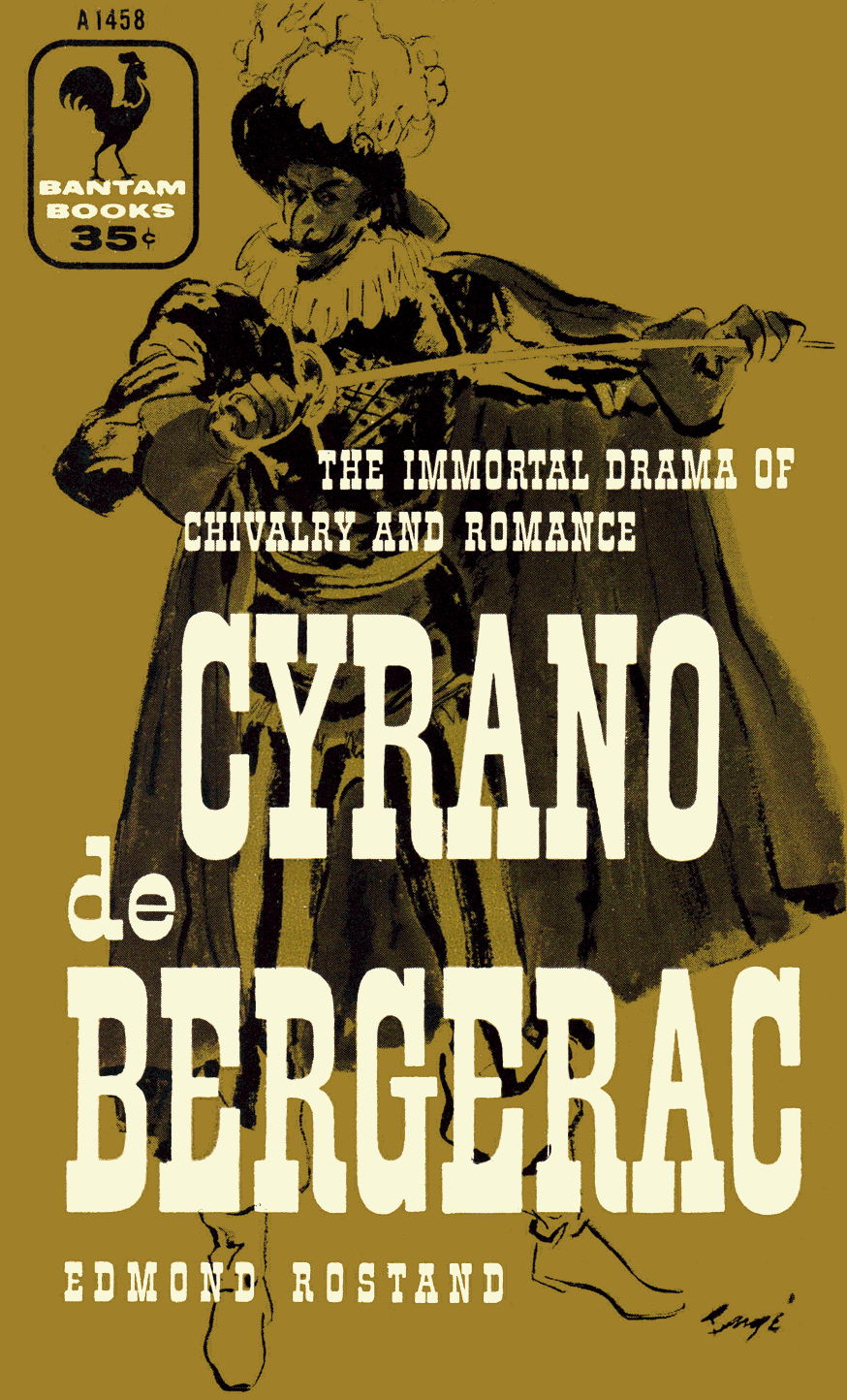
I renamed the adventure En coulisse de l'Hôtel de Bourgogne—Backstage at the Hôtel de Bourgogne—for the simple reason that I’d recently read Cyrano de Bergerac and the even simpler reason that some of the Bourgogne’s history in the period—I chose 1637 to put it right smack dab in Three Musketeers territory—is available online. While Jacob Latchkey is a fictional English spy required by the original Grand Theater adventure, the rest of the Comédiens du Roi are real actors and actresses of the Troupe Royale; they would have played at the Hôtel de Bourgogne during that period and they very possibly would have acted in Pierre Corneille’s La Place Royale.

Biblyon the Great
This zine is dedicated to articles about the fantasy role-playing game Gods & Monsters, and other random musings.