

A Contrived Example of Game Play
When you’re procrastinating in units of years, you can get a lot not done. — Paul Graham (How to Do Great Work)
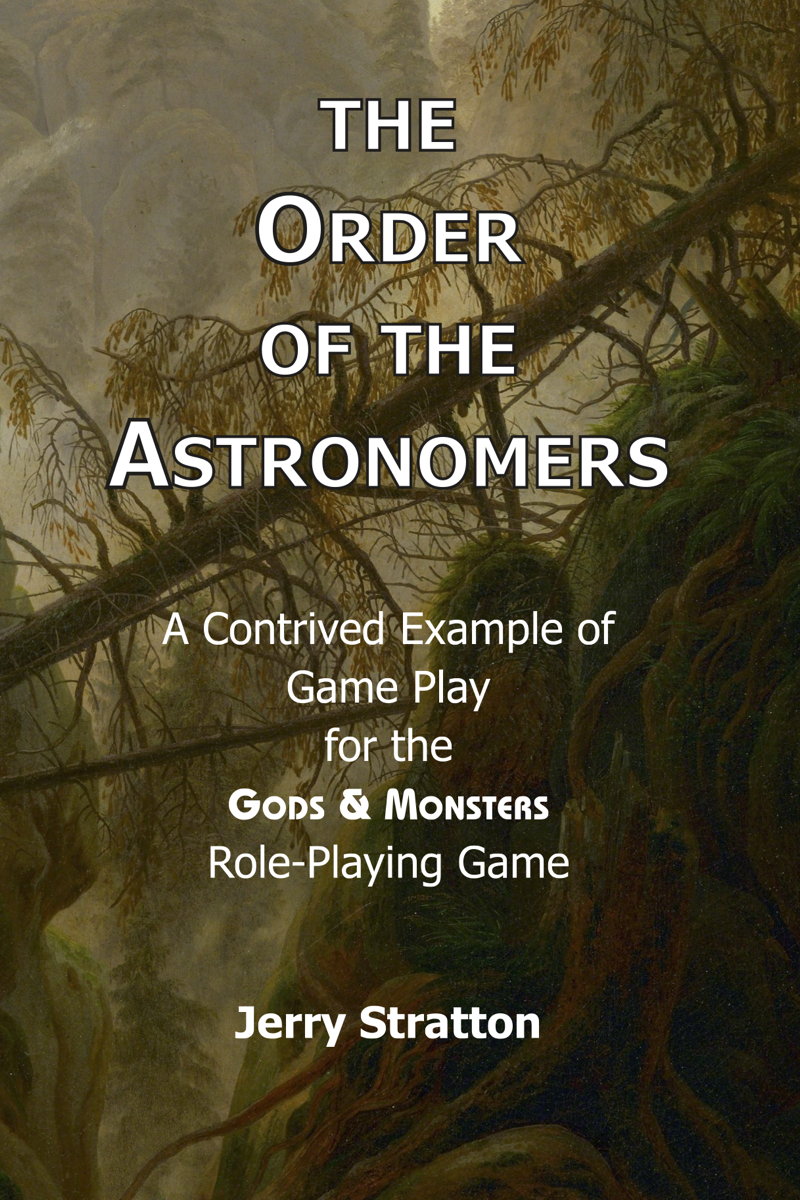
I’ve started work again on making sure all of my Gods & Monsters game books are available in print. The first new release is my “contrived example of game play”, The Order of the Astronomers. It’s a “story” that follows four of the example characters in the rulebook as they adventure through the introductory adventure, The Lost Castle of the Astronomers. The characters I chose for the fictional players to play are Charlotte Kordé (monk), Gralen Noslen (sorceror), Sam Stevens (thief/warrior), and Will Stratford (warrior).
The point of this book is that the characters make choices like players make choices. The world responds like an Adventure Guide would respond. Footnotes throughout the story explain the rules in play during that encounter or for that action.
The Order of the Astronomers, like all of the books I want to make available in print, has long been available as a free downloadable PDF and as a web page. Unlike the other books, however, it isn’t a rulebook. It’s an example of how the rules work. I wanted to do it first because I wanted to go through it and make sure the notes about the rules were correct. It is a basic introduction to the game. I refer directly to it in the introductory adventure:
This is the same adventure that the sample characters went through in The Order of the Astronomers. New players should read that story first. The goal is not necessarily surprise (although the characters will almost certainly run into things that the fictional players’ characters did not), but an exercise in “what if?” What would the players like their characters to do differently? How will the players use their own characters’ abilities?
This is also an exercise in role-playing. The players will know, ahead of time, things that their characters do not know. This is always the case: players always know things that their characters do not, and their characters know things the players do not. Role-playing is a balance between acting as players and ignoring character knowledge, and acting as characters, ignoring player knowledge. How will your players and your group handle this? Different individuals and groups will come to different balances. This otherwise simple adventure will require your group to face this issue head-on.
I also wanted to add before-and-after character sheets so that you can see how characters change, mechanically, over the course of game play. I’ve done my best to ensure that the post-adventure character sheets reflect what happened during the adventure. Some of the characters gained experience for using mojo; most of the characters bought things and gained skills. Gralen acquired spells that were useful during the adventure.
This was an interesting project to begin with, and it remained interesting during the editing. As I wrote in the footnote to Will’s miraculous survival in the final fight, there were things that I would have done differently if I were writing this as a scripted narrative—either as a novella or as a comprehensive explanation of the rules.
This book is neither of those; it is in fact not a story at all, thus the scare quotes in the first paragraph of this post. It is an example of what game play could look like, with an explanation of the relevant rules as they come up. It was more important to show that roleplaying games must not be scripted than it was to, for example, show how the death rules work, or make some character arc fit a standard writerly narrative. Either of those would have required scripting, and tabletop roleplaying by definition must not be scripted.
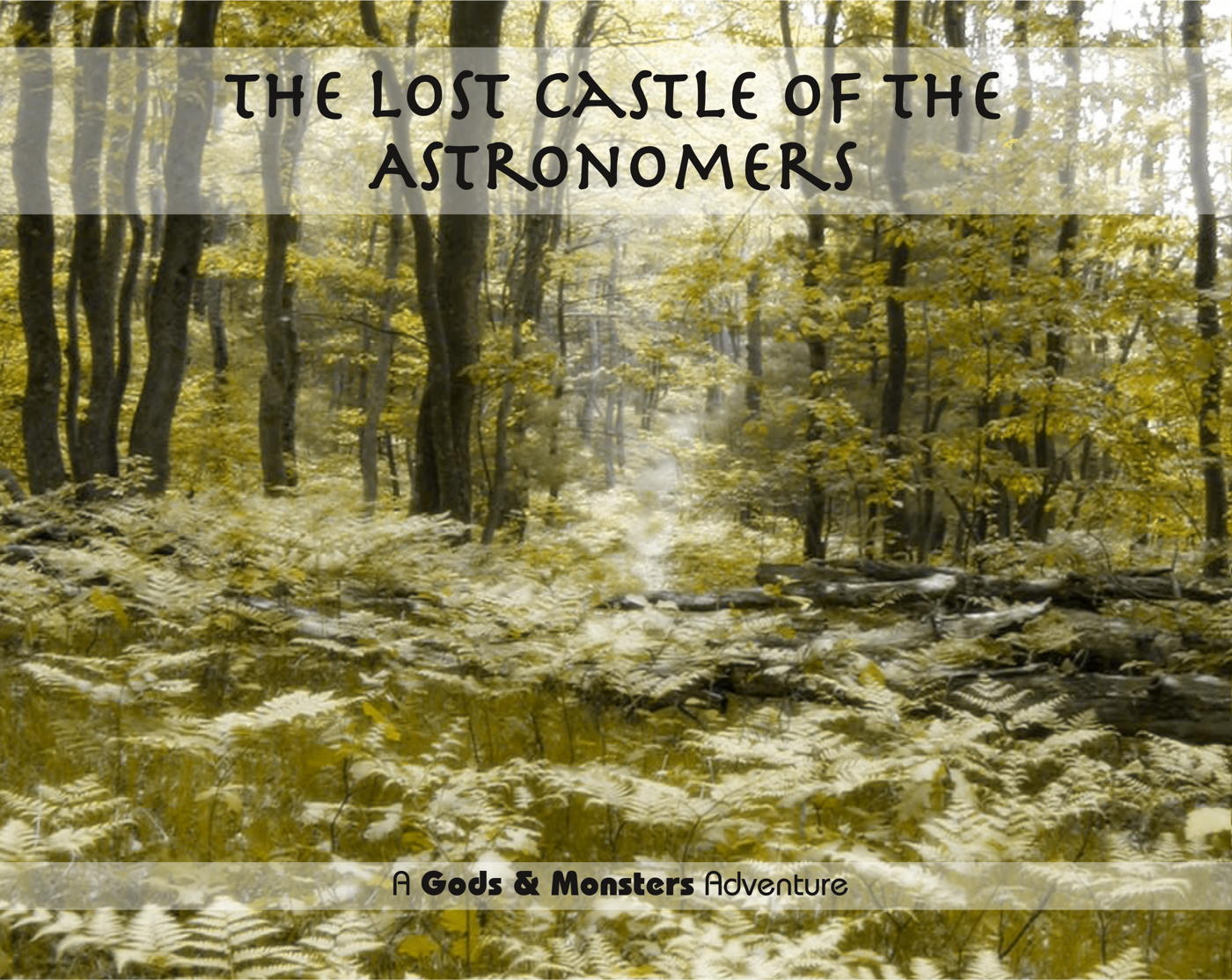
The adventure that the fictional player characters experience in The Order of the Astronomers.
The back cover blurb explains the goal of the book. It’s about how the players direct their characters, not how a writer directs his characters.
What happens in a Gods & Monsters adventure? How do the game rules reflect what the characters do? How do players direct their characters in response to the game world?
The Order of the Astronomers is an example of what might happen when player characters discover a lost castle deep in the forest, travel to it, and investigate it… and what they do when they encounter monsters, traps, and fantastic treasures!
One of the big changes is that this is now in a book format for reading rather than a large format more common for rules. The original was 8-½ by 11 because that was the easiest to print out at the time. It was also easier to provide notes about the rules in boxes right alongside where the rules were used by the fictional players. I’d always meant to eventually convert it to a standard mass market paperback format, but recognized that this would make the notes-alongside-fiction format much more difficult.
I also considered changing it to the wider-than-tall format of the rulebooks. That would certainly have made the notes easier to display, but this book isn’t rules. While 9 by 7 is a great format for rules with tables, it is a horrible format for casual reading.
The reason that I originally wanted to use mass market paperback dimensions is that when I started the reformat I still preferred mass market paperbacks myself. They were easier to carry around so that I always had something to read. They fit in a back pocket. But that mass market size proved too small for the asides about how the characters’ actions, and the consequences of those actions, reflected the rules of Gods & Monsters. Even at 6 by 9 I had to switch from the sidebars of the original 8-½ by 11 version and instead use footnotes.
Even more importantly, since then—tying back into the quote at the top of the post—I’ve stopped carrying multiple books with me when just going out to the doctor or to a meeting. I carry at most one book, and it’s easier, then, for it to be a hardcover or larger paperback. If I finish that one book before returning home, I switch to one of the many ebooks I have on my phone.
I didn’t even have a phone that could do ebooks when I started this project.
That said, The Order of the Astronomers is a nice little read. Reading it myself makes me want to start running a regular game of Gods & Monsters again… which is part of the point of the book!
You can download The Order of the Astronomers as a PDF or read it online. Or you can purchase it in print on Lulu.com or on Amazon•. The rulebooks are and will remain only available in print on Lulu, because Amazon doesn’t have a 9 by 7 format.
book
- The Order of the Astronomers: Jerry Stratton at Lulu storefront (paperback)
- What happens when player characters discover a lost castle deep in the forest, travel to it, and investigate it? What do they do when they encounter monsters, traps, and fantastic treasures?
- The Order of the Astronomers•: Jerry Stratton at Jerry Stratton on Amazon.com (paperback)
- What happens when player characters discover a lost castle deep in the forest, travel to it, and investigate it? What do they do when they encounter monsters, traps, and fantastic treasures?
- Order of the Astronomers
- Follow the adventures of Sam Stevens, Gralen Noslen, Will Stratford, and Charlotte Kordé as they delve into the abandoned castle of the Order of the Astronomers. Start here if you’re new to the game or to role-playing games in general.
- Order of the Astronomers (full PDF)
- PDF version of Order of the Astronomers
bookstores
- Cookbooks on Lulu and Amazon
- I have several books and reproductions available on Lulu, and a few books available on Amazon. On Lulu especially, it helps to buy more than one book at a time to reduce shipping costs per book.
- What else can I buy from Lulu?
- If you’re looking to get more bang for your shipping buck, consider ordering one of these along with the It Isn’t Murder post-podcast edition.
Gods & Monsters
- Gods & Monsters Rules
- All rules on creating characters and playing the game. This is what you’ll be using most as both player and adventure guide.
- Lost Castle of the Astronomers
- This dungeon crawl is suitable for three to six characters of first to third level. This is the basic adventure that Charlotte, Gralen, Sam, and Will went through in The Order of the Astronomers.
More Gods & Monsters
- Variant Species: The Golden Servant
- “I am a golden god.” Well, a golden hero, anyway. But you’re a golden hero subject to the whims of unknown sorcerors. The Golden Servant is the perfect specialty species for the sporadic player.
- Was table-top gaming inevitable?
- Gods & Monsters rolls an 18 for age today, pioneer game writer Greg Stafford died two weeks ago, and stories about the early days of gaming has me wondering, was the discovery of table-top gaming a perfect storm, or was it inevitable?
- The Great Falling War, Revisited
- Delta’s D&D Hotspot revisits the falling wars, and provides a surprising bit of information about the lethality of falling.
- Twenty Questions about Gods & Monsters
- Brendan at Untimately asks twenty questions about D&D-like games.
More role-playing games
- It’s not about the levels
- One powerful tool to fight the video-game-ification of roleplaying games is the use of levels to avoid a code-level interaction between character sheet and advancement.
- The Seven Samurai
- Probably the most influential samurai film, starring Toshirô Mifune and directed by Akira Kurosawa. It inspired more than just samurai: “The Magnificent Seven” was “Seven Samurai” remade into one of the most influential westerns.
- Highlander
- A great movie, with a good commentary, and poor video quality. Recent price drop makes it a worthwhile purchase.
- Excalibur
- Hard to go wrong for the price, and this is the best retelling of the Arthurian saga that I’ve seen on screen. It also includes some early parts by Patrick Stewart, Liam Neeson, and Gabriel Byrne.
- Ghostbusters
- This is a very funny movie, and a very nice DVD. Dan Aykroyd, Harold Ramis, and Bill Murray, and later Ernie Hudson kick ghost ass as New York City has supernatural troubles of “biblical proportions”.
- One more page with the topic role-playing games, and other related pages