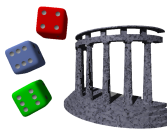
I played my first role-playing game on October 31, 1981. I was a high school senior in rural Michigan, in a tiny town of about nine hundred people. After escorting my younger brother and sister trick-or-treating, I met the people who would join me every Friday or Saturday evening for the rest of my senior year. I expected a fantasy-themed Candyland. What I got was an open-ended question.
You guide your horses up the long dusty road to the castle. At the entrance an iron portcullis blocks your way into the darkness beyond. You see shapes moving inside, and you can hear a river nearby. What do you do next?
We played the game around our dining-room table. Mom made popcorn. I’m pretty sure we went from creating new characters to killing them in a single night. From then on we gamed on the pool table in the basement, safe from parents and younger eyes.
Playing Dungeons & Dragons was like waking up groggy on Christmas morning. This was a completely different kind of game, unlike any of the board games I’d played, unlike any of the card games my parents played. It wasn’t Candyland, Monopoly, or Hearts. It was a game of infinite choice.
When we were gaming, we were inside a world of fantasy fiction. I had already read The Hobbit and probably The Lord of the Rings, because I read just about everything fantasy in our small-town library. Probably also The Sword of Shannara and A Wizard of Earthsea. Turning that sort of experience into a game just clicked; that such a thing was possible meant that the world made sense after all.
Of course I was also an avid comic-book reader. One of the first things I did after discovering Dungeons & Dragons was start writing rules for a superhero role-playing game. In school, when I finished my schoolwork, I’d pull out my notebook and think about how superpowers could be defined by a game’s rules.
Or I’d pull out the notes on my own Dungeons & Dragons world, a huge island covered in castles, caverns, and dungeons. Having no idea what a gaming map was supposed to look like, I used graph paper from math class and drew the entire Isle of Mordol fifty feet to the square. It took 35 sheets and completely covered the pool table we gamed on. You can see it at godsmonsters.com/mordol. I ended up taping the map into seven scrolls each five sheets long. When the characters moved from one area to another, I’d unroll the scroll up or down, or if they’d moved laterally I’d roll up the current scroll and unroll a new one.
The island was a few miles wide. Its climates ranged from desert to snowy mountain, forest to jungle. You had to suspend disbelief with a rocket, but suspend we did. We had a blast.
In that first Hallowe’en game we used the first version of the Basic D&D rules. For Christmas that year I got the newer Basic D&D boxed set, the second version. This was the version available in the toy stores where my parents shopped. When our cousins, whose parents ran a variety store one town over, discovered Dungeons & Dragons, they added a game shelf to their store. We got a family discount on the Advanced Dungeons & Dragons books, the more complex version available in specialized gaming stores. We used all of those books, at the same time, to play our game.
As in Hollywood, where every actor sooner or later wants to direct a movie, every gamer someday, even if only once, feels the urge to design and run their own adventure. Two of us took turns as referee, or Dungeon Master in the game’s lingo (the game master, or GM, the same role as the Adventure Guide in Gods & Monsters). When I wasn’t pitting them against my crazed magical island, I played the cleric Elzaac, a priest of the Norse god Thor. Elzaac explored deserted castles, banged monsters with a hammer, called on Thor to smite monsters with magic, and took their treasure.
When we weren’t playing Dungeons & Dragons, my brother ran a post-apocalyptic game by the same company. In Gamma World the dungeons weren’t the ruins of ancient castles but the ruins of the modern world. We were mutated creatures trying to survive a world long-destroyed by nuclear war.
I went to college the next year. An hour or so after my parents dropped me off I was sitting in my dorm room, my cot covered with partially-unpacked boxes. A sophomore from California walked by, noticed my rulebooks, and invited me to join the D&D group he was starting. I was all set to roll up a new cleric of Thor just like Elzaac, when I discovered that our new Dungeon Master’s real name was… Thor. I made quick use of my pencil’s eraser—always write your new characters in pencil—and introduced Praxos, cleric of Ra.
Praxos and his companions set out into the Fell Pass, a long tunnel through the Barrier Peaks, the only shortcut to something, I don’t remember what. In the Fell Pass we met displacer beasts, and huge rats—and in D&D huge rats are dangerous to first-level characters—and things we never did find out what they were. I know this because I still have the map I drew as we explored the tunnels.
Praxos’s companions were O’Shin, a Halfling thief, Dweomer, a Gnome illusionist, Kellson, a human magic-user, and probably a fighter or two. O’Shin was famous for having an 18 dexterity but still somehow usually managing to roll higher than 18 on a d20 when attempting some dexterous feat of derring-do. If there were an award for “most resurrections in a role-playing game” he would have won it in our group.
Praxos eventually died by slipping off the side of a mountain. He also failed his roll to grab the side of the trail and hang on; he failed his roll to grab one of his companions; and his companions failed their rolls to grab him. It might have been possible to drag his battered body to a shrine for resurrection, but Praxos’s magical staff also failed its roll and blew up at the bottom, leaving a crater and no trace of the fourth-level Curate of Ra. I have his final character sheet. When he died he carried wolfsbane, garlic, and a silver holy symbol. He knew the spells cure light wounds, augury, and slow poison. He had already used detect evil, hold person, and silence that fateful day.
I had no problem accepting his death and moving on: Praxos’s character sheet contains notes on my next character in that campaign, a Paladin of Vanimaar. As far as I recall, Sheridan the Paladin survived to the end of the campaign. The last of Sheridan’s character sheets has him at 8th level with a warhorse named Daren. I assume he rode off into the sunset.
We played as much as we could in those four years, and not just Dungeons & Dragons. We played the superhero game Villains & Vigilantes along with my own Men & Supermen. We tried other fantasy games: DragonQuest and the horribly complicated Chivalry & Sorcery. C&S’s science fiction counterpart, Space Opera, was so complicated it took an entire night just to make a character, and the game was too much even for a bunch of computer geeks. But we did, later, play the simpler Traveller and the even simpler Star Frontiers. Traveller is remembered today for a unique, at the time, character creation process which produced detailed random backgrounds—with the risk that a character could die before you even started playing.
There was also Call of Cthulhu, based on the works of H.P. Lovecraft, where the goal wasn’t surviving against unbeatable odds or coming back with great treasures. It was maintaining personal sanity in the face of unspeakable horrors. Success didn’t mean being a hero or killing monsters. It was remaining sane. The best way to succeed in Call of Cthulhu was to die in style or retire outside of an asylum.
When three members of my college group found ourselves across the country in San Diego in the nineties, we had a new breed of games to play. The Internet helped fuel a role-playing resurgence. We still played Advanced Dungeons & Dragons (now in its second edition) but we also played a completely new genre called cyberpunk.
Back in college Thor had foreseen the need for a near-future, cybered-up role-playing game, but we’d never been able to get our heads around the concept enough to write one that worked. In the nineties we played the games of those who had: Cyperpunk 2020 and the cyberfantasy hybrid Shadowrun. You can still see some of what we did in the latter game if you search for The Neo-Anarchists Guide to Everything Else online.
And since goth was in, Vampire took Call of Cthulhu to a different level. We role-played undead creatures struggling vainly to maintain a grip on their fading humanity in the face of unquenchable hunger. Just about every vampire movie or television series today seems to be inspired by this game.
There were so many characters. The clerics Elzaac and Praxos, Sheridan the Paladin, Snapdragon the superhero, Sam Hain the prohibition-era private eye, Sony Louis-Rollando the cyber-warrior. And many more lost in the character sheets of time.
In the twenty-first century, we began playing Gods & Monsters.
Role-playing games are not for everyone, but those of us who enjoy them find it hard to understand why. Who wouldn’t enjoy a game that makes such a profound use of individual creativity in a shared setting? A game that stimulates creativity and challenges intelligence in a way that is so incredibly fun? A game designed to be played without rules?
Even Space Opera, with its night-long character creation process, has finite rules and infinite possibilities. For all practical purposes, role-playing games have no rules. The rules are there to assist you as player and as game master, but for the most part they are inconsequential. There are no rules for the vast majority of things your character does. In Gods & Monsters, for example, when your character gets in a fight there are rules to let you know how to keep your character alive, rules that let you reasonably know your character’s chance of success. But when you decide to sneak into town at night or take over the local ruling council, the die rolls you make are inconsequential compared to all of the shared decisions between you and the Adventure Guide. Those decisions have no rules to cover them.
Rules are, in a sense, sandboxes that the characters occasionally enter, places where the players know more precisely the process of what will happen to their characters. But most of the action in a game takes place in the negative space outside the rulebook.
Someday we might be able to program computer games that have no rules, but for now role-playing games are an unequalled means of passing the time with friends and strangers. No other non-physical game produces stories about game sessions like role-playing does. Old adventures come up in conversations just like glory days for football players. Do you remember the time Xen-Arbus tried to get the attention of an oblivious farm family—and ended up waking the dead? We had to fight three skeletal ghouls! Or the time Xen-Arbus decided that there were definitely monsters behind this one door, opened it and rushed in to surprise them—in full plate armor—to discover a forty-foot down stairway behind the door? He couldn’t hear for the rest of the adventure.
If you read books and wonder what might have happened if the characters took a different path, you might enjoy role-playing games. If you’re the person who always yells at movie characters to pick up the gun!, and of course they never do, you might enjoy role-playing games. If you accept the fiction that dragons are real, and then argue about how realistic they are within the fiction, you almost certainly will enjoy role-playing games.
In Gods & Monsters you’ll find adventure, excitement, and really wild things. If every gamer eventually wants to run a game, then every gamemaster eventually wants to write a custom game. After twenty years of gaming, I knew what I wanted game rules to do, and I knew what kind of game I wanted to play. I wrote Gods & Monsters to be that game, and made it open source so that you can do the same with it.
However you play, may the dice be ever in your favor.