

Splendors of the Past: Lost Cities of the Ancient World
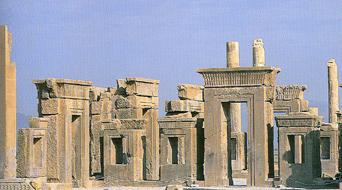
Persepolis crowned one of the world’s first great empires. Persia stretched from Egypt to India.
“Like the adventurers of old in Egypt, you will delve into long forgotten tombs,” says the back page of Gods & Monsters, “but in your adventures magic will fuel danger and creatures of myth will stalk the darkness. You will search uncharted wilderness for lost knowledge and hidden treasure.”
How many fantasy gamers are not fans of Raiders of the Lost Ark? The fictional adventurous archaeologist comes closest to the fantasy adventurer. “Splendors of the Past” caters to our love for lost ruins. The photo of ruined Angkor in the jungles of southeast Asia on the title page cannot but inspire a fantasy game master to take pen in hand and write.
From the Sumerians of Mesopotamia to the Land of the Sinhalese Kings, there are seven cities or sets of cities covered, each with a description of the archaeology going on at the site, photos of the ruins, and descriptions of the then-current theories of what happened in the cities. The book is copyright 1981 and appears to have been written mostly in the seventies. Each section is written by a different author. It is from the National Geographic Society, so it may be comprised of articles or expanded articles from National Geographic.
The photographs are marvelous, as you would expect from National Geographic. Look on page 12 for a photo of the great audience hall of Persepolis in Iran, bare columns rising to the sky, no longer bearing a ceiling, standing open to the desert, mountains rising in the distance. To a gamer, there are adventures behind every pillar.
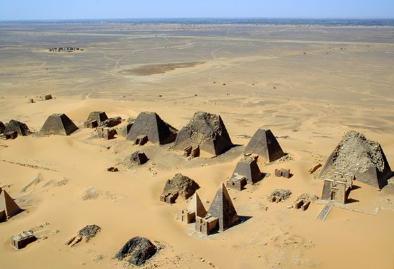
Meroë’s cemeteries form the largest collection of pyramids in the world. From Francis Geius under Creative Commons Attribution-NoDerivs 1.0 license.
In the land of Kush, there is a photograph of the “distinctive kiosk at Naqa” a small building, doors leading beneath arches and decorative corners, looking like exactly the sort of thing that fantasy adventurers would fear to enter.
Angkor is amazing, lost cities in the jungle, trees overgrowing stone buildings, great Buddhas looking out over three directions above giant, snaking-arched entranceways. Look for the temple-mountain of Bayon on pages 204 and 205. It is breathtaking, and ripe for populating with strange mystics, weird creatures, and magical treasure.
In Sri Lanka, “the land of the Sinhalese kings”, a “wealth of sculpture lies scattered through the ever-encroaching jungles. An eroded guardstone, displaying a prince with a sweeping multiheaded-cobra headdress, rises out of the rank vegetation” next to a wide stone stairway leading up to the top of a vegetation-covered hill. It looks for all the world like a vision out of Lord of the Rings. For a more imposing structure, look for the “engineering marvel of palaces, pleasure gardens, and temples” atop a six-hundred foot tall rock jutting out of the Sri Lanka jungle. A third of the way to the top, visitors must pass between a pair of massive lion’s feet while climbing stairs to the top.
The text is also often useful from a gaming standpoint, reproducing translated versions of what the ancients wrote.
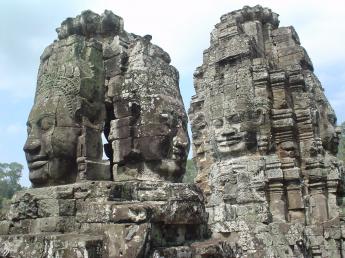
The Bayon temple at Angkor contained 54 towers bearing colossal faces and designed to present an almost natural appearance as it rises above the forest.
“Only the gods live for ever.... As for mankind, numbered are their days, Whatever they achieve is but wind.” Wisdom of ancient Sumer seems a fit epitaph for the weathered mound rising above the stark Mesopotamian plain. Yet here at Uruk lay inscribed clay tables that evidenced mankind’s enduring achievement of literacy.
And here’s something useful from Pompeii if you’re looking to create some Roman-style restaurants and bars:
The most easily identified shops are the thermopoliums, with their L-shaped masonry counters for the serving of refreshments. Few street corners were without them; more than a hundred such bars have been counted in Pompeii. The counters held large earthenware jars containing food and wine. Pompeians were particularly fond of heated wine. Some of these shops also had kitchens that prepared hot stew; others boasted back rooms where customers could sit and talk and perhaps gamble while they drank.
Very useful information like this is scattered through the book.
In several places, the book uses wonderfully evocative paintings, mostly by Lloyd K. Townsend, to illustrate the city life of the city in question.
This book is unfortunately out of print, but it isn’t hard to find and it isn’t too expensive. I picked mine up for $10 at a local book fair. If you see it, I strongly recommend taking a look at it. It is fascinating, and for fantasy game masters very inspiring.
- Splendors of the Past: Lost Cities of the Ancient World•
- The photos alone are inspirational for fantasy game masters; the text describing these lost cities provides a lot of ideas for lost cultures and ancient ruins.
- Angkor at Wikipedia
- “Over a period of 300 years, between 900 and 1200 AD, the Khmer empire produced some of the world's most magnificent architectural masterpieces on the northern shore of the Tonle Sap.”
- Meroë at Wikipedia
- “Meroë is the name of an ancient city on the east bank of the Nile north of Khartoum, Sudan. This city was the capital of the Kingdom of Kush for several centuries.”
- Persepolis at Wikipedia
- “Persepolis was an ancient capital of the Persian Empire. The site is marked by a large terrace on which are the ruins of a number of colossal buildings, all constructed of dark-grey marble from the adjacent mountain. Especially striking are the huge pillars, of which a number still stand erect.”
More gaming history
- The Cult of the Cult of Gygax™
- It was never a secret to us back in the day that the staff at TSR played the game themselves, and that they played the game with custom rules and custom worlds.
- Was table-top gaming inevitable?
- Gods & Monsters rolls an 18 for age today, pioneer game writer Greg Stafford died two weeks ago, and stories about the early days of gaming has me wondering, was the discovery of table-top gaming a perfect storm, or was it inevitable?
- The First Language
- Scholars once believed that, or seriously discussed whether, Hebrew was the first language of mankind. In a fantasy game, there really can have been a first, holy language of the gods.
- Currency and economic policy in the middle ages
- Prices, credit, and currencies. If you know the system, you could make a mint!
- House of Gold, House of Passages
- The emperor Nero’s House of Gold sounds like the backstory of a great megadungeon right under the adventurers’ sandaled feet.
- 18 more pages with the topic gaming history, and other related pages